14 Sep 2026
- 0 Comments
You’ve got your telescope set up in the backyard, or maybe you’re driving out to a dark-sky site outside Portland. You know what Messier Catalog is-a list of 110 fuzzy blobs that Charles Messier originally compiled so he wouldn’t confuse them with comets. But knowing the list and actually seeing all 110 objects in one night? That’s a different beast entirely. This isn’t just about pointing a lens at the sky; it’s about strategy, timing, and knowing which targets are worth your energy when the moon is full or when clouds threaten to roll in.
Most amateur astronomers start with the Moon and planets because they’re bright and easy. Then comes the itch for something deeper-the spiral arms of a galaxy or the glowing gas of a nebula. The Messier Catalog is the gateway drug to deep-sky observing. It’s comprehensive enough to keep you busy for years but structured enough that you can master it. Whether you’re planning a solo session tonight or prepping for the annual Messier Marathon in March, this guide breaks down exactly how to plan your observations without wasting time hunting for things you’ll never see.
Understanding the Messier Catalog Structure
Before you open your star chart, you need to understand what you’re looking at. The catalog isn’t random. It’s organized by discovery date, not by type or location. This means M1 (the Crab Nebula) was found first, and M110 (a satellite galaxy of Andromeda) was added last. For an observer, this ordering is annoying if you want to see similar objects together, but it’s crucial for historical context.
The 110 objects fall into three main categories:
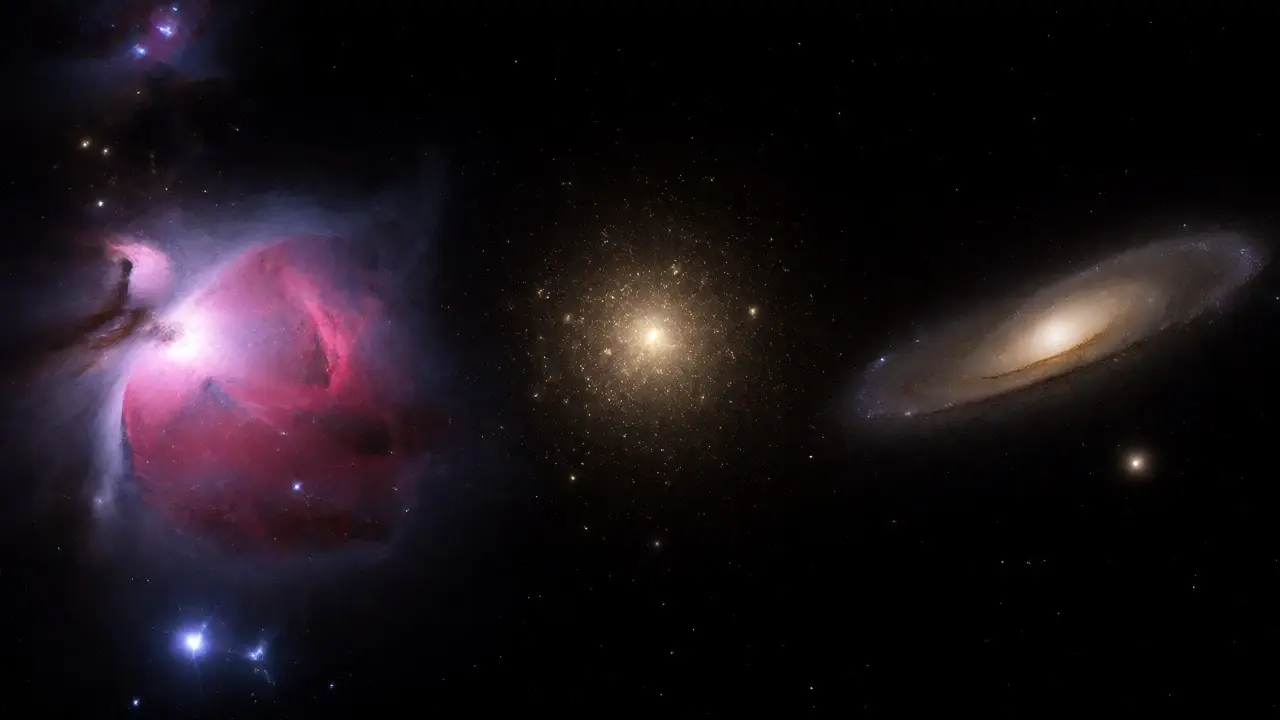
- Nebulae: Clouds of gas and dust. These range from planetary nebulae like M57 (Ring Nebula), which look like smoke rings, to emission nebulae like M42 (Orion Nebula), which glow pinkish-white due to hydrogen ionization.
- Star Clusters: Groups of stars bound by gravity. Open clusters like M45 (Pleiades) are loose and young, often visible to the naked eye. Globular clusters like M13 (Hercules Cluster) are dense spheres of hundreds of thousands of ancient stars.
- Galaxies: Isolated islands of stars. Most are faint smudges in small telescopes. Andromeda (M31) is the brightest and easiest, while others require larger apertures or darker skies.
Knowing these types helps you manage expectations. If you’re using binoculars, you won’t resolve the spiral structure of M51 (Whirlpool Galaxy). You’ll see a gray oval. That’s okay. Adjusting your goals based on your equipment prevents frustration.
Choosing Your Target List Based on Season
You can’t see everything every night. Earth’s orbit changes which constellations are visible at midnight. Trying to hunt for Scorpius objects in January is a waste of time-they’re below the horizon during prime observing hours. Here’s how to break it down by season for mid-northern latitudes:
| Season | Key Constellations | Top Messier Objects | Why Observe Now? |
|---|---|---|---|
| Winter | Orion, Taurus, Canis Major | M42, M45, M81, M82 | Crisp air and high contrast make nebulae pop. Orion is unmistakable. |
| Spring | Leo, Virgo, Coma Berenices | M65, M66, M104, M51 | Galaxy season. Leo Triplet and Virgo Cluster galaxies are well-placed. |
| Summer | Sagittarius, Scorpius, Hercules | M13, M8, M17, M57 | Milky Way core is visible. Best for globular clusters and emission nebulae. |
| Fall | Pegasus, Andromeda, Cygnus | M31, M33, M15, M2 | Andromeda rises early. Great for beginners wanting big, bright targets. |
If you live in a light-polluted city like downtown Portland, stick to Winter and Fall targets. M42 and M31 are bright enough to shine through urban glow. Spring galaxies often disappear under streetlights unless you drive out to the Columbia River Gorge or higher elevations.
The Messier Marathon Strategy
The ultimate test for many observers is the Messier Marathon-seeing all 110 objects in a single night. This happens only once a year, usually around late March, when the moon is new and the sky is clear. But you don’t have to wait for that event to practice the skills.
Planning a mini-marathon requires strict sequencing. You start with objects that rise early and end with those that set late. Miss the window for M13 in summer, and you’ll lose hours trying to catch it near the horizon where atmospheric distortion blurs the view.
Here’s a simplified workflow for a successful night:
- Pre-Plan Your Path: Use software like Stellarium or SkySafari to plot a route. Start with western objects before sunset, move overhead, then finish with eastern risers.
- Check Moon Phase: A waxing crescent sets early, giving you dark hours. A full moon washes out 90% of faint galaxies and nebulae. Don’t bother chasing dim targets under a full moon.
- Set Up Early: Align your mount before twilight ends. Once it’s dark, manual alignment becomes frustrating. Let your telescope cool to ambient temperature to avoid thermal currents distorting images.
- Use Star Hopping: Don’t rely solely on GoTo mounts. Learn to hop from bright stars to faint targets. If your mount fails, you’re still able to observe.
Pro tip: Keep a logbook. Not digital-paper. Write down what you saw, how long it took to find it, and any conditions affecting visibility. Over time, this data reveals patterns in your own observing style and local sky quality.
Equipment Needs: Binoculars vs. Telescopes
You don’t need a $2,000 refractor to enjoy the Messier Catalog. In fact, many observers prefer wide-field views over high magnification. Deep-sky objects are large and diffuse. Cranking up power often makes them invisible.
For beginners, 10x50 binoculars are ideal. They offer a wide field of view, making star hopping easier. You can see M45, M13, and M42 clearly. Add a red flashlight to preserve night vision, and you’re ready to go.
If you upgrade to a telescope, aperture matters more than brand. An 8-inch Dobsonian reflector offers the best value for deep-sky viewing. It gathers enough light to reveal details in globular clusters and shows spiral hints in nearby galaxies. Smaller scopes (4-6 inches) work fine too, but you’ll see less detail in fainter objects like M74 or M77.
Consider filters. An OIII filter boosts contrast on planetary nebulae like M57. A UHC filter helps with emission nebulae like M8. But don’t buy filters until you’ve seen the object unfiltered. Sometimes, no filter gives the most natural view.
Overcoming Light Pollution and Weather
Living in the Pacific Northwest means dealing with cloud cover. September nights are getting longer, but rain is common. Check weather forecasts hourly, not daily. Clear pockets can appear unexpectedly.
Light pollution is another hurdle. Bortle Scale Class 4 skies (suburban) limit you to about 50-60 Messier objects. To see the rest, you need Class 2 or 3 skies. Driving two hours east toward the Cascade foothills can transform your experience. Suddenly, M33 (Triangulum Galaxy) appears as a distinct oval instead of a vague patch.
If you can’t travel, use apps like Light Pollution Map to find nearby dark spots. Even a short drive away from sodium-vapor streetlights improves contrast significantly. Park safely, let your eyes adapt for 30 minutes, and start with bright targets before tackling faint ones.
Common Pitfalls and How to Avoid Them
Many observers quit after their first few sessions because they expect Hubble-quality views. Reality check: Visual astronomy is about detecting subtle shapes and brightness variations. You won’t see color in most nebulae except M42 and M8. Your brain needs training to interpret low-light signals.
Avoid these mistakes:
- Over-magnifying: Using 100x on a galaxy often yields nothing. Try 20-40x first.
- Rushing: Give each object 5-10 minutes. Your eyes need time to detect faint edges.
- Ignoring Collimation: If your mirror telescope isn’t aligned, stars look like doughnuts. Check collimation weekly.
- Forgetting Dew Heaters: Moisture forms on lenses quickly in humid climates. A dew heater keeps optics clear.
Patience pays off. The first time you see M13 resolve into individual stars, it feels magical. That moment comes from preparation, not luck.
How many Messier objects can I see with binoculars?
With good 10x50 binoculars under suburban skies, you can reliably spot about 40-50 Messier objects. Under dark skies, this number increases to 70+. Bright targets like M42, M45, M13, and M31 are always visible, while faint galaxies require optimal conditions.
What is the best month for a Messier Marathon?
Late March is the traditional time for a full Messier Marathon because the moon is typically new, and all 110 objects are above the horizon at some point during the night. However, partial marathons focusing on seasonal subsets can be done year-round.
Do I need a tracking mount for deep-sky observing?
No, a tracking mount is not required. Many observers use alt-azimuth mounts or even handheld binoculars. Tracking helps keep objects centered during long looks, but manual adjustments are manageable for visual observing. Equatorial mounts with slow-motion cables offer smoother control but add cost and complexity.
Why can’t I see colors in nebulae through my telescope?
Human eyes have poor color sensitivity in low light. Rod cells, which dominate night vision, detect brightness but not color. Only very bright objects like M42 show green or pink hues visually. Photographs capture color because cameras accumulate light over minutes, unlike the human eye which integrates over milliseconds.
Is the Messier Catalog still relevant today?
Yes, absolutely. While modern catalogs like NGC contain thousands of objects, the Messier Catalog remains the gold standard for beginners. It covers the brightest and most interesting deep-sky objects, providing a manageable challenge that builds observational skills effectively.