17 Aug 2026
- 0 Comments
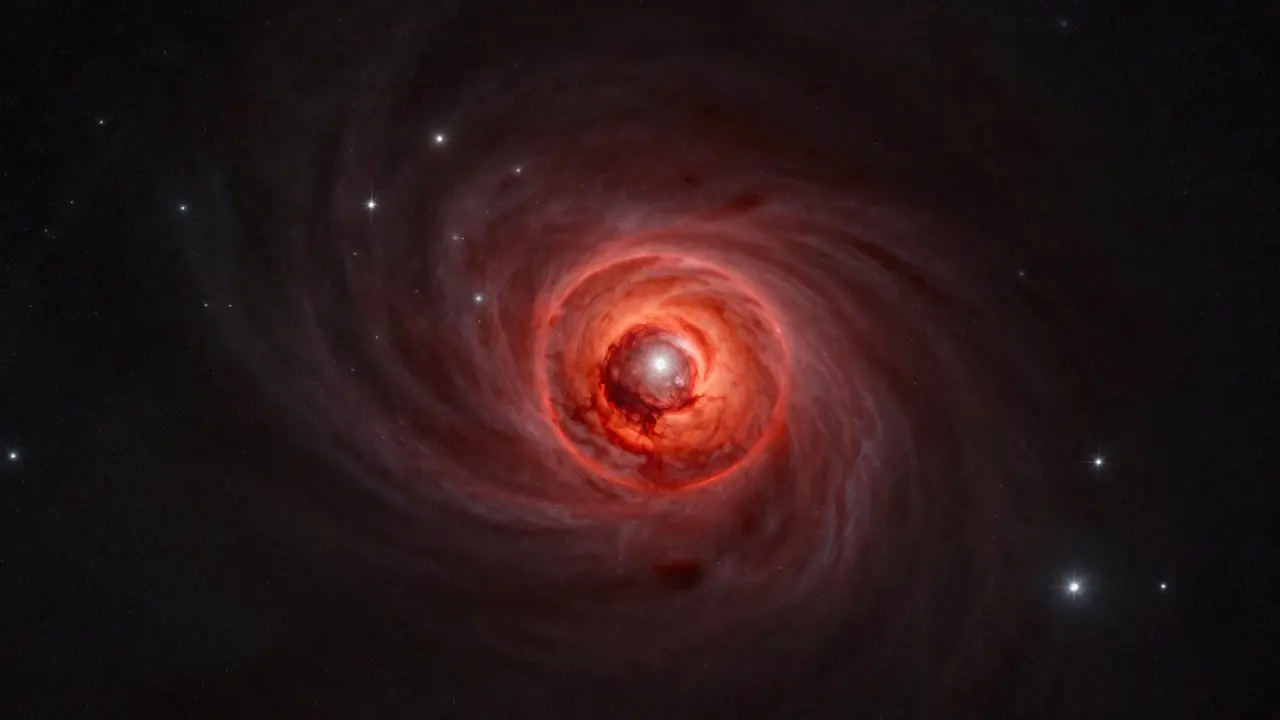
Have you ever looked up at the night sky and wondered why some stars seem to change brightness? You’re not imagining it. For certain stars, this variation is a fundamental part of their existence. These are known as Mira variables, a specific class of long-period red giant stars that undergo rhythmic pulsations in size and luminosity. Unlike the steady glow of most stars, Miras breathe. They expand, cool, dim, then contract, heat up, and brighten again. This cycle can take anywhere from 80 to over 1,000 days, making them one of the most dramatic displays of stellar evolution visible to amateur astronomers.
These stars are not just visual curiosities; they are critical laboratories for understanding how massive stars end their lives. By studying Mira variables, we learn about mass loss, planetary nebulae formation, and the chemical enrichment of our galaxy. If you’ve ever felt intimidated by astrophysics, don’t worry. The physics behind these pulsations is complex, but the observable effects are straightforward. Let’s break down what makes these red giants tick, how they differ from other variable stars, and why they matter to our understanding of the universe.
The Anatomy of a Red Giant Pulsator
To understand why Miras pulse, we first need to look at what they are. A Mira variable is a type of red giant star. At this stage of life, the star has exhausted the hydrogen fuel in its core. The core contracts under gravity, heating up until helium fusion begins. Meanwhile, the outer layers expand dramatically, often becoming hundreds of times larger than the Sun. This expansion cools the surface temperature, giving the star its characteristic deep red or orange hue.
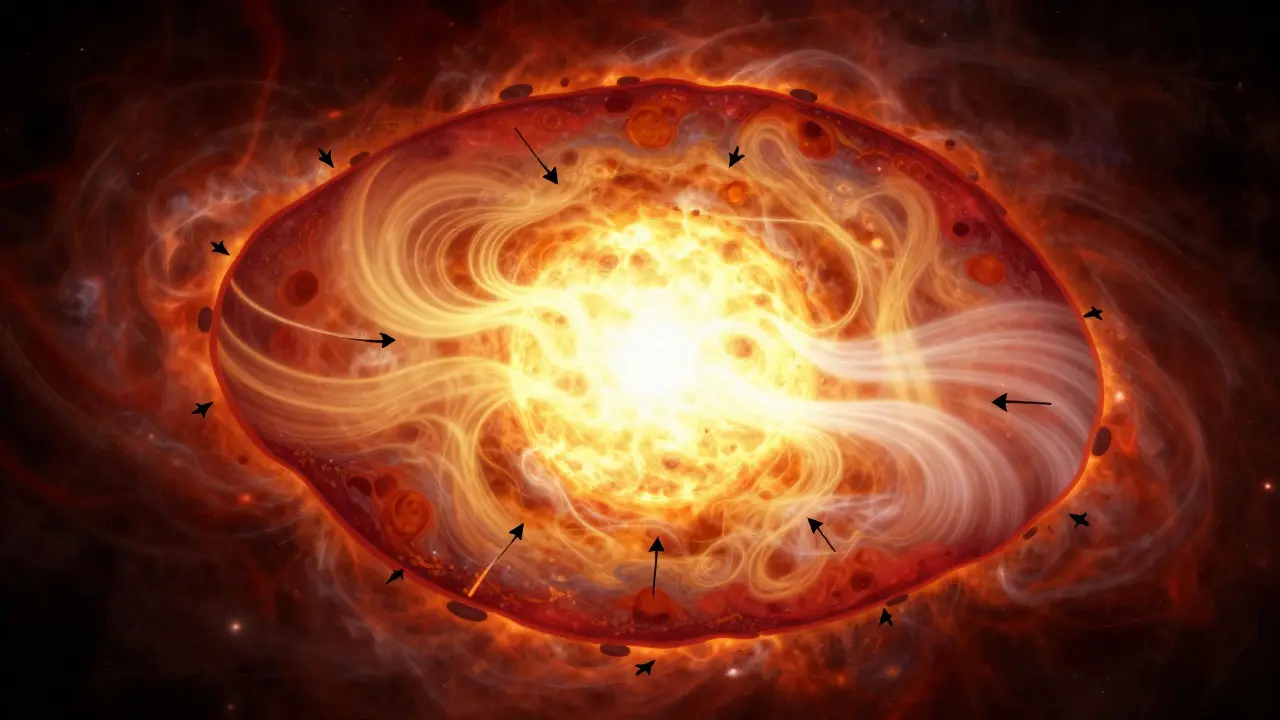
However, not all red giants pulse. The key difference lies in the internal structure and opacity of the outer envelope. In Mira variables, a layer of ionized helium near the surface acts as a "valve." As the star expands, this layer becomes opaque, trapping radiation and energy inside. This trapped energy pushes the outer layers outward further. Once the layer thins out enough to become transparent, the energy escapes, and gravity pulls the star back together. This cycle of trapping and releasing energy drives the pulsation. It’s a self-regulating mechanism where the star’s own atmosphere controls its heartbeat.
Pulsation Mechanisms: The Valve Effect
The driving force behind Mira pulsations is often described using the "valve effect" model. Imagine a piston in an engine. When the piston moves up, it compresses air. Similarly, when the Mira star contracts, the gas in its outer layers gets compressed. But here’s the twist: the opacity of the gas changes with temperature and density. During contraction, the gas heats up and becomes more transparent, allowing energy to escape quickly. This rapid loss of pressure causes the star to fall inward faster than expected. Then, as it expands, the gas cools and becomes opaque again, trapping energy and slowing the expansion. This mismatch between thermal timescales and dynamical timescales creates the oscillation.
This mechanism explains why Miras have such long periods. The outer layers are incredibly diffuse, meaning sound waves (which drive the pulsation) travel slowly through them. The time it takes for a pressure wave to cross the star determines the period. Since Miras are so large, these waves take months to travel from the core to the surface and back. This is why you won’t see a Mira change significantly day-to-day; you need weeks or months to track its full cycle.
Comparison with Other Variable Stars
It’s easy to confuse Mira variables with other types of variable stars, particularly Cepheids. Both are pulsating stars, but they operate on different scales and evolutionary stages. Cepheids are typically blue or yellow supergiants, much hotter and brighter than Miras. Their pulsation periods are shorter, ranging from a few days to a few months. Miras, being cooler red giants, have much longer periods. This distinction is crucial for astronomers because each type serves as a different "standard candle" for measuring cosmic distances. While Cepheids are excellent for nearby galaxies, Miras are used for even farther objects where their extreme brightness makes them detectable despite the vast distance.
| Feature | Mira Variables | Classical Cepheids |
|---|---|---|
| Spectral Type | M (Red) | F to K (Yellow/White) |
| Evolutionary Stage | Asymptotic Giant Branch (AGB) | Post-Main Sequence / Supergiant |
| Pulsation Period | 80 - 1,000+ days | 3 - 100 days |
| Luminosity Variation | Up to 10 magnitudes | Typically 1 - 2 magnitudes |
| Mass Loss | High (forms circumstellar dust) | Low to Moderate |
Observing Miras: What to Expect
If you’re an amateur astronomer, observing Mira variables is one of the most rewarding activities you can do. Unlike double stars or clusters, which remain static, Miras offer a dynamic target. You can watch a star fade from magnitude 2 to magnitude 10 over several months. The prototype of this class, Mira A (Omicron Ceti), is located in the constellation Cetus. It’s easily visible to the naked eye when bright, but disappears into the background noise when faint. Tracking its position relative to nearby fixed stars helps confirm your observations.
When planning observations, keep in mind that the light curve of a Mira is not a perfect sine wave. It’s asymmetric. The star brightens relatively slowly and dims rapidly. This is because the expansion phase is prolonged by the valve effect, while the contraction phase is faster due to gravity. Also, be aware of circumstellar dust. Many Miras eject material into space, forming a shell of dust around the star. This dust absorbs light, particularly in the infrared, and can cause additional variability unrelated to the pulsation itself. This phenomenon, known as "dust veiling," can make the star appear redder and dimmer than expected based on its intrinsic brightness.
The Role of Mass Loss and Dust Formation
Mira variables are major contributors to the interstellar medium. As they pulse, their outer atmospheres become unstable, leading to significant mass loss. This ejected material forms a wind that carries heavy elements like carbon and oxygen into space. Over time, this material condenses into dust grains. Infrared telescopes have revealed that many Miras are surrounded by dense shells of silicate and carbonaceous dust. This dust is not just a byproduct; it plays a crucial role in the star’s cooling process. The dust absorbs ultraviolet light from the hot inner regions and re-emits it in the infrared, helping to drive the stellar wind outward.
This mass loss is so intense that if a Mira were to continue losing mass at its current rate, it would lose half its total mass in a few million years. Eventually, the star will shed all its outer layers, leaving behind a white dwarf and a beautiful planetary nebula. So, every time you observe a Mira, you’re watching a star in its final act, preparing to die and enrich the next generation of stars and planets.
Why Studying Miras Matters
Beyond their beauty, Mira variables are essential tools in modern astrophysics. They serve as standard candles for measuring distances across the universe. Because there is a relationship between their pulsation period and their intrinsic brightness (the Period-Luminosity relation), astronomers can determine how far away a Mira is by measuring its period and apparent brightness. This technique has been refined over decades and is now a cornerstone of extragalactic astronomy. It allows us to map the structure of the Local Group of galaxies and probe the expansion rate of the universe.
Furthermore, Miras help us understand nucleosynthesis-the process by which elements heavier than iron are created. The pulsations mix material from the core to the surface, bringing newly synthesized carbon and nitrogen to the exterior. By analyzing the spectra of Miras, we can identify these elements and trace the history of stellar evolution. This data helps refine models of how stars live and die, providing insights that apply to our own Sun billions of years from now.
Frequently Asked Questions
What is the longest period recorded for a Mira variable?
The longest known periods for Mira variables exceed 1,000 days. Some extreme cases, like R Hydrae, have periods approaching 400 days, while others in distant globular clusters have been measured with periods over 900 days. The theoretical limit depends on the star's mass and radius, but no hard upper bound has been definitively established yet.
Can I observe Mira variables with binoculars?
Yes, absolutely. When at maximum brightness, many Mira variables are visible to the naked eye or with binoculars. Mira A, for example, reaches magnitude 2.0 at peak, which is easily visible without any equipment. However, at minimum, it fades to magnitude 10, requiring a small telescope to see. Binoculars are excellent for tracking the star's position against field stars during its bright phases.
How do Mira variables differ from semi-regular variables?
Semi-regular variables also show periodic changes in brightness, but their periods are less stable and their amplitude variations are smaller. They often have multiple periods overlapping, making their light curves more complex and irregular. Mira variables, by contrast, have a single dominant period and very large amplitude changes (often 5+ magnitudes). Semi-regulars are generally older and less evolved than typical Miras.
Do all red giants become Mira variables?
No. Only a subset of red giants on the Asymptotic Giant Branch (AGB) develop the specific conditions necessary for strong Mira-like pulsations. Factors such as mass, metallicity, and the presence of a binary companion influence whether a star will exhibit Mira behavior. Some red giants remain stable, while others become semi-regular or irregular variables instead.
How does dust affect the observation of Mira variables?
Dust surrounding a Mira variable absorbs visible light and re-emits it in the infrared. This causes the star to appear redder and dimmer than it would without the dust shell. Astronomers must account for this "extinction" when calculating the star's true brightness. Infrared observations are often necessary to penetrate the dust and measure the intrinsic luminosity of the star accurately.