17 Aug 2026
- 0 Comments
Ever looked through your telescope and wondered why the Moon sometimes looks bigger than other nights? Or tried to calculate exactly how much of it is lit up during a gibbous phase? You’re not alone. Most amateur astronomers hit a wall when they try to connect the visual appearance of the Moon with the actual numbers behind it. The angular diameter isn’t just a static number; it changes daily due to the Moon’s elliptical orbit. And the illuminated fraction doesn’t follow a simple linear scale-it depends on the geometry of the Sun-Earth-Moon system.
This guide breaks down the exact formulas you need to calculate both the apparent size of the Moon and its phase illumination. No advanced calculus required, just basic trigonometry and a bit of astronomical data. Whether you’re planning an astrophotography session or just satisfying your curiosity, these calculations will help you understand what you’re actually seeing in the eyepiece.
Why the Moon’s Apparent Size Changes
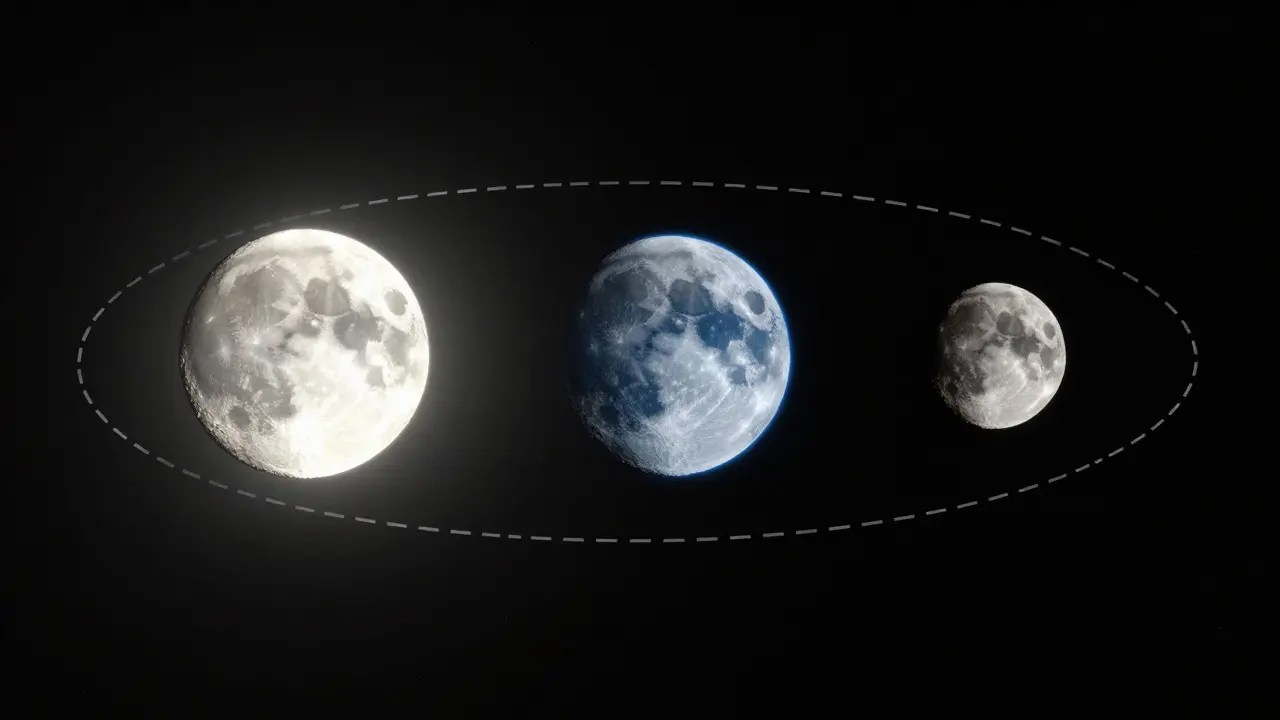
The Moon orbits Earth in an ellipse, not a perfect circle. This means its distance from us varies significantly throughout the month. At perigee (closest approach), the Moon can be as close as 356,500 km. At apogee (farthest point), it stretches out to about 406,700 km. That’s a difference of roughly 14% in distance, which directly translates to a noticeable change in how large the Moon appears in the sky.
Angular Diameter is the angle subtended by an object at the eye of the observer, measured in degrees, arcminutes, or arcseconds. For the Moon, this value typically ranges between 29.37 and 34.05 arcminutes. To calculate this, you use the formula:
- θ = 2 × arctan(R / d)
Where R is the radius of the Moon (approximately 1,737.4 km) and d is the current geocentric distance to the Moon. If you want the result in radians, keep the arctangent output as is. To convert to arcminutes, multiply by 3,437.75. This conversion factor comes from the fact that one radian equals approximately 3,437.75 arcminutes.
Let’s look at a concrete example. Suppose the Moon is at a distance of 384,400 km (the semi-major axis average). Plugging this into the formula gives an angular diameter of roughly 31.0 arcminutes. Now, if the Moon is at perigee (356,500 km), the calculation yields about 33.5 arcminutes. That’s a 7.7% increase in apparent size. In a telescope with a fixed field of view, this difference is easily visible. Your Moon might fill 80% of the frame at apogee but 95% at perigee.
Calculating Phase Illumination
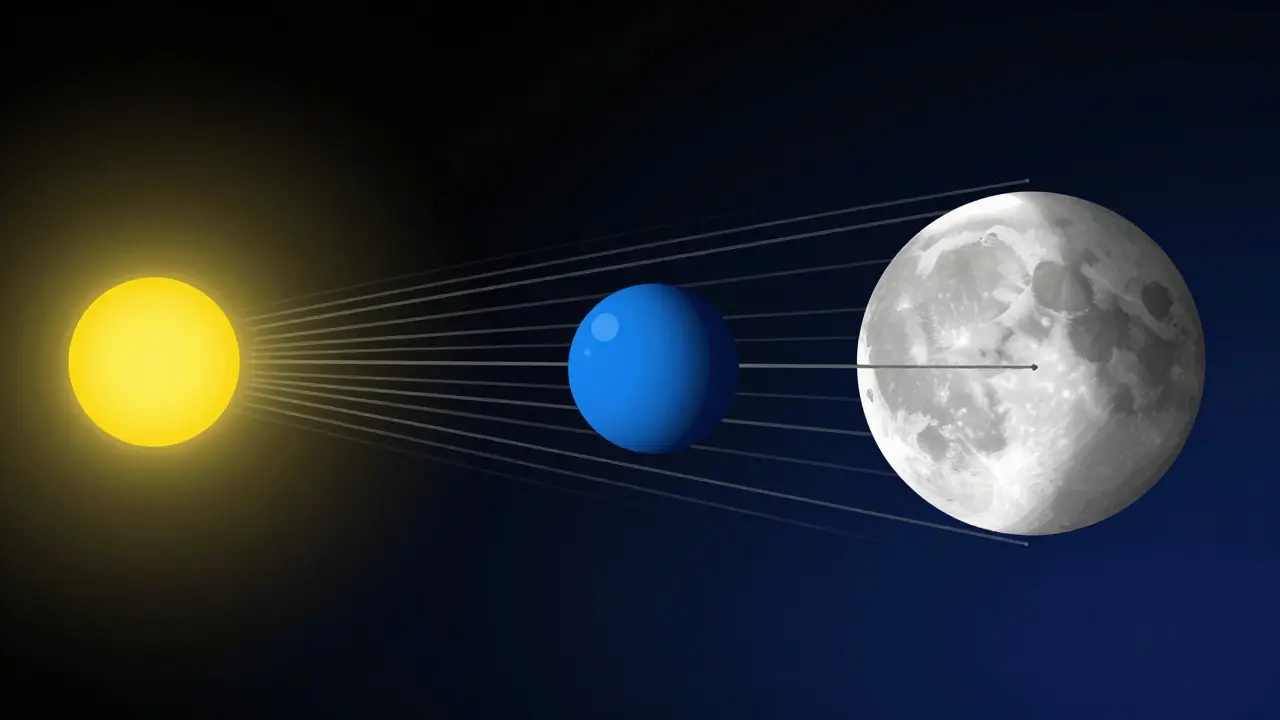
While angular diameter tells you how big the Moon looks, phase illumination tells you how bright it is. This is determined by the phase angle-the angle formed by the Sun, Earth, and Moon. When the Moon is full, the phase angle is 0 degrees, and 100% of the visible disk is illuminated. When it’s new, the phase angle is 180 degrees, and 0% is illuminated.
Phase Illumination is the fraction of the Moon's visible surface that is illuminated by the Sun as seen from Earth. The standard formula for calculating the illuminated fraction (k) is:
- k = (1 + cos(α)) / 2
Here, α is the phase angle in degrees. It’s crucial to note that this formula assumes a spherical body and ignores atmospheric scattering or limb darkening, which are negligible for basic observational purposes. The phase angle itself can be derived from the elongation of the Moon from the Sun. Elongation is the angular separation between the Sun and the Moon as seen from Earth.
If you have access to ephemeris data, you can find the phase angle directly. However, if you only know the date and time, you can estimate the phase angle using the synodic month. The Moon completes a full cycle of phases every 29.53 days. So, if you know how many days have passed since the last New Moon, you can approximate the phase angle as:
- α ≈ 360° × (days since New Moon / 29.53)
This approximation works well for general planning but lacks the precision of actual ephemeris data. For high-precision work, such as timing lunar occultations, always use a reliable almanac or software like Stellarium or Celestrak.
Combining Size and Brightness: Practical Examples
Now let’s put these concepts together. Imagine you’re setting up your telescope for a lunar observation on August 17, 2026. According to recent ephemeris data, the Moon is currently in its waxing gibbous phase, about 7 days past Full Moon. The distance to the Moon is approximately 395,000 km.
First, calculate the angular diameter:
- Radius R = 1,737.4 km
- Distance d = 395,000 km
- θ = 2 × arctan(1,737.4 / 395,000) ≈ 0.00881 radians
- Convert to arcminutes: 0.00881 × 3,437.75 ≈ 30.3 arcminutes
Next, estimate the illumination. Since it’s 7 days past Full Moon, the phase angle is roughly 360° × (7 / 29.53) ≈ 85.5°. Wait-this is where intuition often fails. Seven days after Full Moon is actually closer to First Quarter in terms of age from New Moon, but we are measuring from Full. Let’s correct the logic: If it’s 7 days *after* Full Moon, it is approaching Last Quarter. The phase angle increases from 0° at Full to 180° at New. So, 7 days after Full is roughly 7/29.53 of the way to New. The phase angle α is approximately 85.5°. Using the illumination formula:
- k = (1 + cos(85.5°)) / 2
- cos(85.5°) ≈ 0.078
- k = (1 + 0.078) / 2 ≈ 0.539
So, the Moon is approximately 54% illuminated. Combined with an angular diameter of 30.3 arcminutes, you now have a complete picture of the target. This information helps you choose the right focal length. A smaller, partially illuminated Moon allows for higher magnification without losing detail in the terminator region.
| Orbital Position | Distance (km) | Angular Diameter (arcmin) | Illuminated Fraction (Example) |
|---|---|---|---|
| Perigee | 356,500 | 33.5 | Varies by phase |
| Average | 384,400 | 31.0 | Varies by phase |
| Apogee | 406,700 | 29.4 | Varies by phase |
Common Pitfalls and How to Avoid Them
One frequent mistake is assuming the Moon’s size is constant. Many beginners use the average angular diameter (31 arcminutes) for all calculations. While this is fine for rough estimates, it leads to errors in astrophotography framing. If you’re shooting a supermoon, using the average size will cause the Moon to overflow your sensor or camera frame. Always check the specific distance for your observation date.
Another pitfall involves the phase angle calculation. Some observers confuse elongation with phase angle. Elongation is the angle between the Sun and Moon as seen from Earth. Phase angle is the angle at the Moon between the Sun and Earth. For the Moon, these two angles are nearly identical because the Earth-Moon distance is small compared to the Earth-Sun distance. However, for outer planets, they differ significantly. Stick to the phase angle formula for lunar calculations to avoid confusion.
Finally, don’t forget atmospheric refraction. Near the horizon, the Moon appears slightly larger due to optical illusions and atmospheric distortion, but this doesn’t change the actual angular diameter calculated from distance. Refraction affects the position, not the size, so your mathematical model remains valid regardless of altitude.
Tools and Resources for Precision
You don’t need to do all these calculations by hand. Several tools can automate the process while still allowing you to understand the underlying math. Online ephemeris generators provide real-time data on lunar distance and phase. Apps like Stellarium or SkySafari display the current angular diameter and illumination percentage instantly. For those who prefer manual control, spreadsheets can be set up with the formulas provided above. Input the date, retrieve the distance from an API or table, and let the spreadsheet handle the trigonometry.
Understanding these calculations empowers you to make better observational decisions. You’ll know when to expect a larger Moon, how much light to expect from a partial phase, and how to frame your shots accurately. It turns guessing into knowing.
Frequently Asked Questions
What is the average angular diameter of the Moon?
The average angular diameter of the Moon is approximately 31.0 arcminutes, or 0.52 degrees. This value corresponds to the Moon at its semi-major axis distance of 384,400 km.
How does the Moon's distance affect its brightness?
Brightness follows the inverse square law. As the Moon gets closer, its apparent brightness increases. At perigee, the Moon is about 14% brighter than at apogee due to the reduced distance, independent of phase illumination.
Can I calculate the Moon's phase using only the date?
Yes, you can estimate the phase using the synodic month length of 29.53 days. Count the days since the last New Moon and divide by 29.53 to get the fraction of the cycle completed. Multiply by 360 to get the approximate phase angle.
Why does the Moon look bigger near the horizon?
This is known as the Moon illusion. It is a psychological effect caused by comparison with terrestrial objects. The actual angular diameter calculated from distance remains constant whether the Moon is at the horizon or overhead, barring minor atmospheric refraction effects.
What is the maximum difference in the Moon's apparent size?
The maximum difference occurs between perigee and apogee. The angular diameter ranges from about 29.4 arcminutes at apogee to 33.5 arcminutes at perigee. This represents a variation of nearly 14% in apparent size.