17 Aug 2026
- 0 Comments
Staring at the night sky without a map feels like trying to read a book in a foreign language. You see the dots, but you don't know the story they tell. That’s where seasonal star tours come in. Instead of memorizing hundreds of stars all at once, you break the sky down into manageable, nightly chunks based on what is actually visible right now. This approach turns overwhelming data into a simple, repeatable habit that fits your local horizon and time of year.
You don’t need expensive gear or a PhD in astrophysics to master this. You just need a clear view, a basic understanding of how Earth orbits the Sun, and a structured plan. By aligning your learning with the seasons, you ensure that every star you study is bright enough to see and high enough in the sky to identify easily. Here is how to build your own night-by-night curriculum for the coming months.
Why Seasonal Timing Matters More Than You Think
The night sky changes dramatically over the course of a year because of Earth’s orbit around the Sun. When you look up at 10 PM in August, you are seeing a completely different slice of the Milky Way than you would in January. If you try to learn constellations that are currently below the horizon or lost in the sun glare, you will waste time looking for objects that aren’t there.
Seasonal planning solves this by focusing on the "zodiacal" background and the major asterisms that dominate each quarter. For example, in late summer, the galactic center is prominent, making it the perfect time to learn about Sagittarius and Scorpius. In winter, Orion rises high in the south, offering the brightest and most recognizable patterns in the northern hemisphere. By matching your study list to the season, you leverage natural visibility to reinforce memory through repetition.
Building Your Nightly Learning Cycle
A sustainable learning plan doesn’t require hours under the stars. Ten to fifteen minutes per night is often enough if you are focused. The key is consistency rather than duration. Here is a simple framework to structure each evening’s session:
- Pick One Target: Choose a single constellation or asterism as your primary focus for the night. Don’t try to learn three at once.
- Locate the Anchor Point: Find the brightest star or most distinctive shape in that pattern first. Use this as your hook to find the rest.
- Trace the Outline: Physically trace the lines of the constellation with your hand or a laser pointer (if safe) to engage muscle memory.
- Identify Key Stars: Learn the names of the two or three brightest stars in the pattern. Knowing Alpha Centauri or Betelgeuse gives you a permanent reference point.
- Note the Context: Look at what surrounds your target. Is it near the Moon? Is it close to another familiar pattern? Context helps with future identification.
After ten nights, you should have a solid grasp of one major region of the sky. After three months, you will have covered the entire zodiacal band. This method prevents cognitive overload and builds confidence because you are always looking at something you can actually see.
August and September: The Galactic Core Window
If you are starting your tour in mid-August, you are in luck. The heart of our galaxy is directly overhead for much of the evening in the Northern Hemisphere. This is the densest part of the Milky Way, packed with nebulae, star clusters, and dark dust lanes. It is visually stunning even to the naked eye.
Your primary targets for these weeks are Sagittarius is a zodiacal constellation containing the galactic center, characterized by its teapot-like asterism formed by six bright stars. Also known as The Archer, it sits low in the southern sky during early evenings. The "Teapot" shape is easy to spot, with Antares marking the top of the handle. Next door is Scorpius, which features the red supergiant Antares. Its curved tail makes it impossible to miss once you know what to look for.
Don’t ignore the Summer Triangle, an asterism formed by Vega, Deneb, and Altair. While not a formal constellation, it serves as a reliable compass for finding Cygnus, Lyra, and Aquila. Mastering this triangle gives you a fixed reference point for the entire summer sky.
October and November: Transitioning to Autumn Giants
As the days shorten, the summer stars begin to set earlier. By October, the focus shifts to the autumn equinox markers. The Pegasus Square, also known as the Great Square of Pegasus, becomes the dominant feature in the eastern sky after sunset. This geometric shape is one of the easiest patterns to recognize and serves as a gateway to Andromeda.
From the corner of the square closest to the ground, you can follow a line of fainter stars toward Andromeda is a large spiral galaxy located approximately 2.5 million light-years from Earth, visible to the naked eye as a fuzzy patch. This is the most distant object visible without a telescope, making it a rewarding milestone for any stargazer. Learning Andromeda in autumn is easier than in other seasons because it is higher in the sky and away from the bright glow of the summer Milky Way.
Also watch for Cassiopeia rising in the east. Its distinct W-shape is a reliable marker for finding Polaris, the North Star. Connecting these patterns creates a mental map of the northern circumpolar region, which remains visible year-round.
December and January: The Winter Showcase
Winter offers the most spectacular display of bright stars in the Northern Hemisphere. Orion dominates the southern sky, flanked by Taurus and Gemini. The contrast between the cool blue-white stars and the warm orange-red giants is striking.
Start with Orion is a prominent winter constellation featuring the Orion Nebula and the bright stars Betelgeuse and Rigel. Its belt of three equally spaced stars is the most famous asterism in the sky. Use the belt to locate Sirius, the brightest star in the night sky, by extending the line downward. Then extend it upward to find Aldebaran in Taurus. This single motion connects three major constellations instantly.
This season is ideal for learning navigation techniques using the Big Dipper and Cassiopeia to find Polaris. Since the winter sky is generally clearer and darker due to lower humidity and less light pollution from foliage, it is the best time to practice identifying fainter stars and deep-sky objects.
February and March: Spring Rising Patterns
As winter fades, the spring constellations rise in the east. Leo, Virgo, and Boötes become prominent. These constellations are less bright than their winter counterparts but form interesting shapes that reward careful observation.
Look for the Sickle of Leo, a backward question mark shape formed by several bright stars. At the end of the sickle is Regulus, a brilliant blue-white star. Nearby, you will find Arcturus in Boötes, one of the brightest stars in the sky. The phrase "Arc to Arcturus, then Spica" is a classic mnemonic for moving from the Big Dipper to these spring stars.
This period is also good for observing the Pleiades, a tight cluster of young blue stars in Taurus. As the winter sky sets, the Pleiades remain visible for longer periods, making them a consistent anchor point for early morning observations.
April and May: The Zodiacal Return
By April, the cycle begins to turn back toward the zodiacal constellations. Aries and Taurus are still visible, but Gemini and Cancer are rising. This is a transitional period where the sky feels emptier because many of the bright stars are setting early or rising late.
Use this time to review and consolidate what you learned in previous months. Revisit the Summer Triangle and check if you can still identify it when it is low in the west. Practice finding the Pegasus Square again, as it will be setting soon. This repetition reinforces long-term memory and prepares you for the return of the summer stars.
Focus on the fainter stars in this season. Since the bright anchors are fewer, you must rely more on subtle patterns and relative brightness. This challenges your observational skills and improves your ability to navigate the sky in any season.

June and July: Preparing for the Galactic Peak
Summer returns with the rise of the galactic core. By June, the Milky Way is becoming more prominent in the pre-dawn hours. Use this time to prepare for the peak visibility in August. Start identifying the fainter stars in Sagittarius and Scorpius while they are still low on the horizon.
Practice using a star chart or app to verify your identifications. Apps like Stellarium or SkySafari can overlay constellations on the live sky, helping you connect the digital map with the real world. However, try to spend at least half your time without the app to train your eyes and brain to work independently.
Tools and Techniques for Effective Learning
You don’t need a telescope to start. Binoculars with 7x50 or 10x50 magnification are excellent for spotting double stars and small clusters. They provide a wider field of view than telescopes, making it easier to orient yourself in the sky.
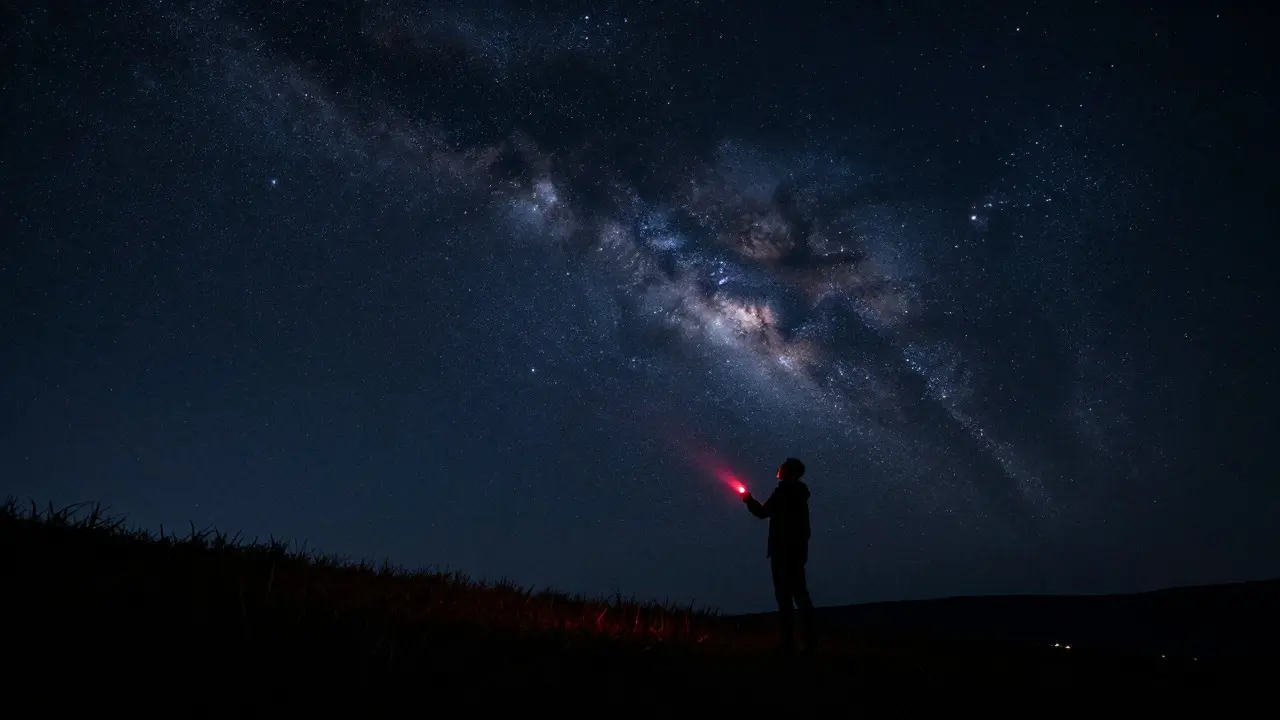
- Red Light: Use a red flashlight to preserve your night vision. Blue light ruins dark adaptation for up to 30 minutes.
- Star Charts: Print seasonal star charts or use a tablet. Rotate the chart so north is up and match it to the horizon.
- Journaling: Keep a simple log of what you saw each night. Note the date, time, weather, and specific stars identified. Reviewing this log after a month reveals your progress clearly.
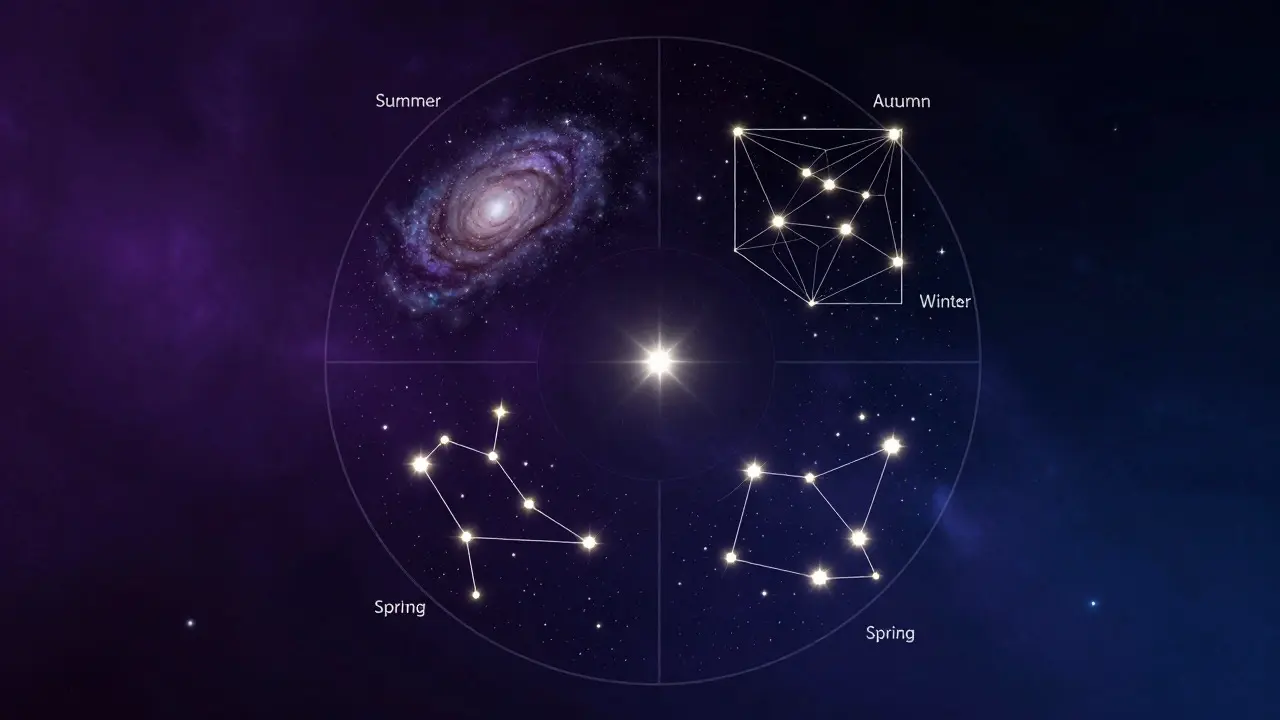
| Season | Primary Constellations | Key Asterisms | Best Time to Observe |
|---|---|---|---|
| Summer (Aug-Sep) | Sagittarius, Scorpius, Cygnus | Summer Triangle, Teapot | 9 PM - Midnight |
| Autumn (Oct-Nov) | Pegasus, Andromeda, Cassiopeia | Great Square, W-Shape | 8 PM - 11 PM |
| Winter (Dec-Jan) | Orion, Taurus, Gemini | Orion's Belt, Hyades | 9 PM - Midnight |
| Spring (Feb-Mar) | Leo, Virgo, Boötes | Sickle of Leo, Spring Triangle | 10 PM - Dawn |
Common Pitfalls to Avoid
One of the biggest mistakes beginners make is trying to learn too much too fast. Resist the urge to memorize every star name. Focus on the patterns first; the names will follow naturally as you encounter them repeatedly. Another common error is ignoring light pollution. If you live in a city, drive to a darker location at least once a week. The difference in visibility is profound and will make your learning experience significantly richer.
Finally, don’t let bad weather discourage you. Cloudy nights are perfect for reviewing star charts, reading about mythology associated with constellations, or planning your next observation session. Consistency matters more than perfect conditions.
Do I need a telescope to learn constellations?
No, a telescope is not necessary for learning constellations. The human eye is well-suited for identifying large-scale patterns in the sky. Binoculars can enhance the experience by revealing double stars and small clusters, but they are optional. Focus on naked-eye observation first to build a strong foundation before introducing optical aids.
How long does it take to memorize all the constellations?
It typically takes 6 to 12 months of consistent nightly practice to confidently identify all 88 official constellations. However, you can recognize the major zodiacal and circumpolar constellations within 3 months. The key is regular exposure rather than intensive cramming. Each season brings new patterns, so the learning process is continuous.
What is the best app for stargazing beginners?
Stellarium and SkySafari are widely regarded as the best apps for beginners. Both offer accurate star maps, constellation overlays, and detailed information on celestial objects. Stellarium is free and open-source, while SkySafari offers a more user-friendly interface with additional features. Use these tools as a training aid, but aim to reduce reliance over time.
Can I learn constellations in the Northern Hemisphere if I live in the Southern Hemisphere?
Yes, but you will need to adjust your expectations. Some constellations are visible from both hemispheres, such as Orion and Scorpius, while others are exclusive to one side. If you live in the Southern Hemisphere, focus on Crux (the Southern Cross), Carina, and Centaurus instead of Ursa Major and Cassiopeia. Many online resources allow you to select your latitude to generate customized star charts.
How do I deal with light pollution when stargazing?
Light pollution reduces the number of visible stars and washes out the Milky Way. To mitigate this, observe during the darkest part of the night, avoid facing streetlights, and use red light sources. If possible, travel to a designated Dark Sky Park or rural area for monthly sessions. Even a slight increase in darkness can reveal dozens of additional stars and deep-sky objects.